
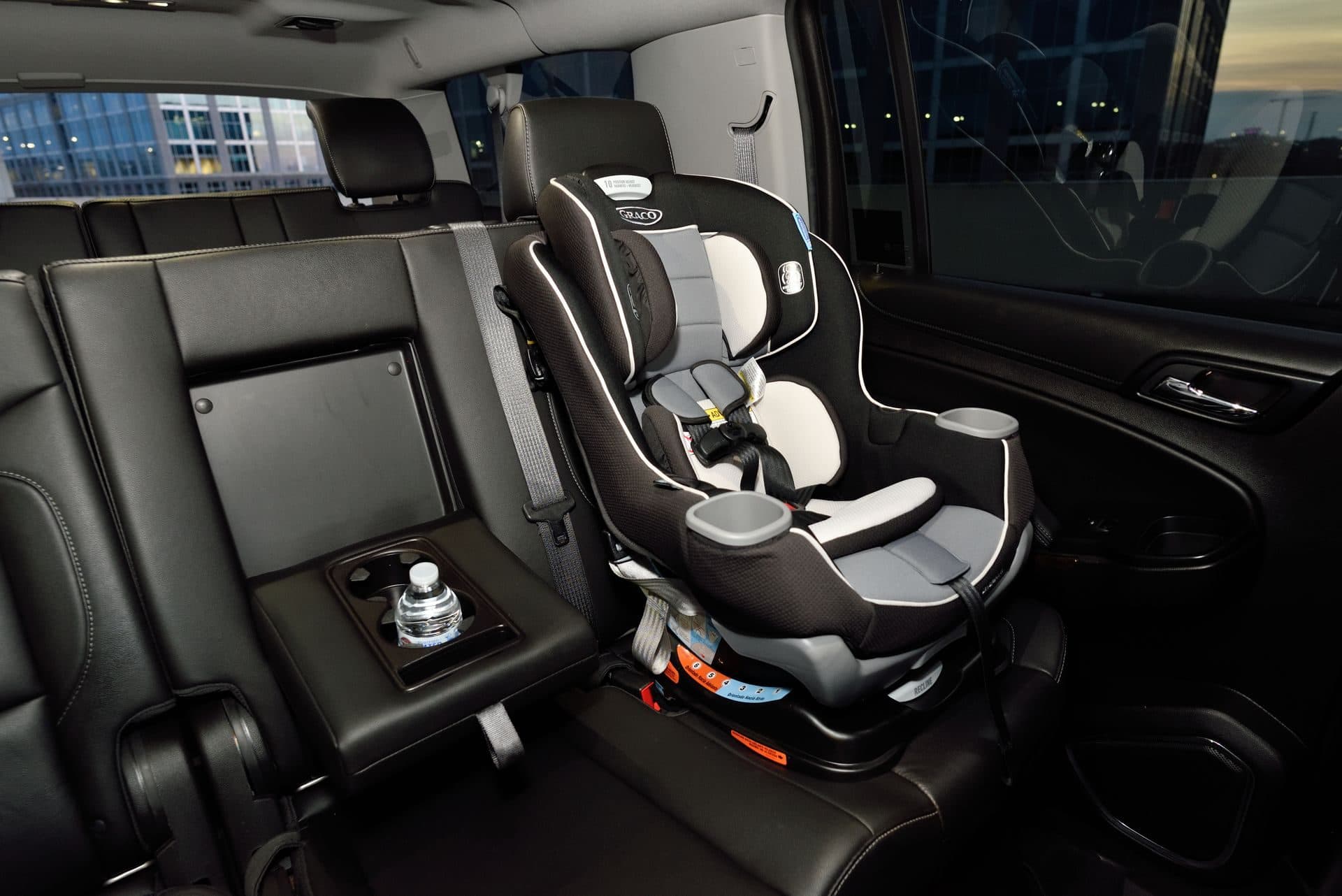
Child car seats in Belgium: rules and solutions
In Belgium, the rule depends not on age but on height: below 1.35 m, a suitable child restraint is compulsory. There are exceptions, but they are narrow.
The rule: under 1.35 m, a suitable seat
Article 35 of the Highway Code sets out the principle: children under 18 who are shorter than 135 cm must travel in a child restraint suited to them. The deciding factor is therefore height, not age: a ten-year-old who is 1.32 m tall is still covered by the rule, while a teenager of 1.40 m wears a seat belt like an adult. The rule does not apply to vehicles with more than eight passenger seats in addition to the driver's seat, such as coaches.
Two further points complete the rule. A seat belt cannot be shared: each child has their own seat. And in seats without a seat belt, no child under three may be carried, nor, in the front, any child under 1.35 m. You are also free to keep using the booster seat beyond 1.35 m, as long as the child is within the seat's weight range: the belt then sits better across the shoulder and pelvis.
- Every child under 18 who is shorter than 1.35 m must travel in a restraint suited to their height and weight.
- A rear-facing seat must never be fitted in front of an active front airbag.
- i-Size seats keep children rear-facing until at least 15 months, whatever their weight.
- In a taxi without a child seat, a child under 1.35 m must travel in the back.
- With us, infant carriers (Maxi-Cosi), child seats and booster seats are requested when booking.
Which seat for which weight and height
Two approval standards coexist. The older one, R44, classifies seats by weight group; the more recent one, R129, known as i-Size, classifies them by the child's height. i-Size seats require children to travel rear-facing until at least 15 months, whatever their weight. An R44-approved seat that you already own can, in principle, still be used. In all cases, check the approval label and read the instructions before fitting.
The weight ranges overlap on purpose. Only move up to the next seat when the child's head is above the top of the backrest or the maximum weight has been reached, never before: the seat from the lower group generally offers better protection. For a booster seat, choose a high-back model with side protection, an adjustable headrest and a guide that positions the belt at shoulder height.
- Rear-facing infant carrier, group 0+: 0 to 13 kg
- Child seat, rear- or forward-facing, group 1: 9 to 18 kg
- Booster seat, ideally high-back, groups 2 and 3: 15 to 36 kg
Rear-facing: why, and never in front of an airbag
In a frontal collision, a baby in a rear-facing seat has its head and body supported by the back of the seat: the force of the impact is spread over a large area and the neck is protected. This is crucial at that age, as a baby's head is proportionally much heavier than an adult's. Hence the rule: an infant seat is always fitted rear-facing, never the other way round.
One ban is absolute: no rear-facing seat in front of an active front airbag. The Highway Code allows it only if the airbag has been deactivated or deactivates itself automatically and reliably. The front seat is not off limits to children of any age, provided the appropriate restraint is used; the rear seats nevertheless remain the safest. In a chauffeur-driven car, the front passenger seat is in any case rarely the best place for a child.
Taxis, a third child, occasional trips: the exceptions
The first exception is that taxis are exempt from the general requirement: a child under 1.35 m may travel in a taxi with no child seat, but never in the front. Be careful with the word taxi: in Brussels, the 2022 ordinance grants this status, for the purposes of the Highway Code, only to rank taxis. For a chauffeur-driven car booked in advance, ask for the appropriate seat.
Two other exemptions concern ordinary cars. If two child seats are fitted and there is no room for a third, a third child aged three or over may travel in the back using the seat belt. On an occasional, short trip, a driver who is not the child's parent may also carry a child aged at least three in the back, wearing a seat belt, if no child seat is available. These options are legal, but far less safe than a proper seat.
Travelling with children: booking with us
Three types of seat are available on request, to be specified when booking: an infant carrier (Maxi-Cosi) for babies from 0 to 13 kg, a child seat for 9 to 18 kg and a booster seat for children from 15 to 36 kg. Give the approximate age, weight and height of each child, so that the team can provide the seat that is genuinely right. When requesting a quote for a sightseeing tour or a chauffeur by the hour, include this information in the service details.
Think about capacity too. A baby takes up a full seat: two parents and two children exceed the three passengers of an Economic, Green or Business sedan. The Atemia Van, which takes up to seven passengers, accommodates the family, the seats and the luggage without having to calculate the space down to the last centimetre. For an airport transfer, flight tracking means tired children are not kept waiting if the plane arrives earlier or later than expected.
Child car seats
My child is ten and 1.32 m tall: is a booster seat still compulsory?+
Yes. Belgian law goes by height: until they reach 1.35 m, a child under 18 travels in a suitable restraint, whatever their age. At ten, this is usually a booster seat approved for 15 to 36 kg. You may even keep using it a little beyond 1.35 m if the child weighs less than 36 kg and is comfortable in it.
Can a baby seat be fitted in the front of the car?+
Yes, on one strict condition: the front passenger airbag must be deactivated, or absent. A rear-facing seat in front of an active airbag is prohibited, because the airbag would inflate against the back of the seat, right next to the baby's head. The law allows children in the front at any age in a suitable restraint, but the rear seats remain the best protected.
Do the rules change on a trip to Germany or Luxembourg?+
The rules of the country you are driving in apply, and there the threshold is higher: 1.50 m in Luxembourg, and in Germany 1.50 m or the twelfth birthday, whichever comes first. A ten-year-old who is 1.40 m tall can therefore do without a booster seat in Brussels but need one again in Cologne or Luxembourg City. For an international transfer, mention it when booking so that the booster seat stays on board for the whole journey.
How many children can travel in a chauffeur-driven sedan?+
The sedan takes three passengers in total, children included, since each child must have their own seat. One adult and two children, each in their own restraint, therefore fit in an Economic, a Green or a Business. Beyond that, or as soon as the luggage piles up, choose a Van, for up to seven passengers. Let us know the number and ages of the children so that the seats can be arranged.
Also worth reading
Need a private driver or a transfer?
Available 24/7, we are at your service.