
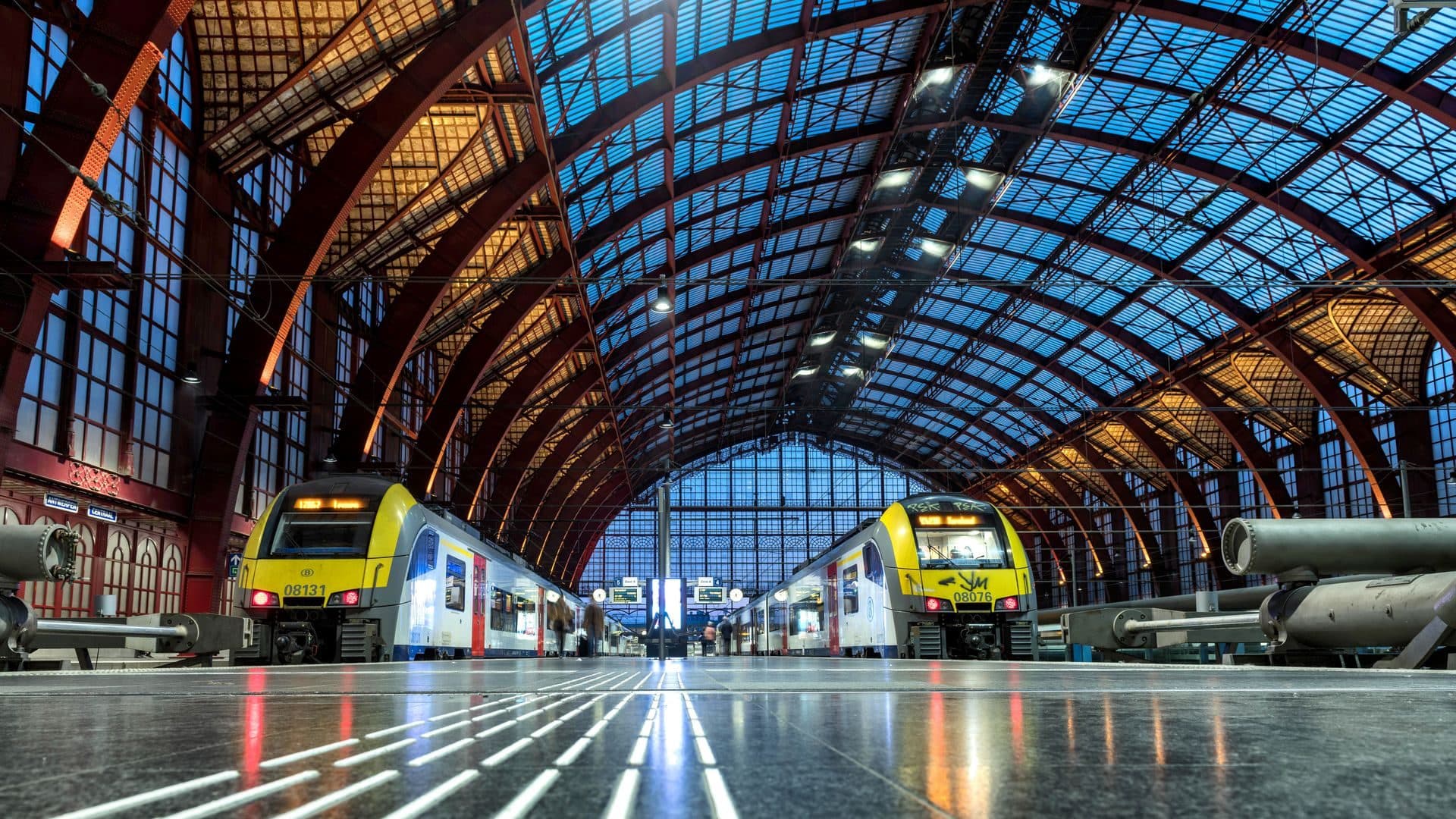
Private driver at Antwerp-Central station
Three levels of platforms, two façades, a diamond district closed to cars: at Antwerp-Central, it pays to know in advance which exit to take and on which side the car will be waiting.
A railway cathedral on several levels
Designed by Louis Delacenserie and completed in 1905, Antwerp-Central station owes its nickname of ‘railway cathedral’ to the dome that crowns its waiting hall. Since its redevelopment in the early 2000s, it has been more than a simple terminus: six terminating tracks beneath the great iron train shed on level +1, four more on level −1, and four through tracks on level −2, in a tunnel dug beneath the city. Between level +1 and level −1, level 0 houses the ticket offices and shops.
This layout has a very practical consequence. Trains that continue beyond Antwerp, including the Eurostar and Eurocity Direct services linking Brussels with Rotterdam and Amsterdam, normally use the deepest level. Arriving from the Netherlands on level −2, you ride up two levels of escalators before catching sight of the dome. The meeting point is set in advance, usually in the great waiting hall, and your driver then guides you to the exit nearest the car.
- Meet in the concourse or outside the right façade, on the Astridplein or Kievitplein side.
- A driver who understands the +1, −1 and −2 level layout and carries your suitcases to the vehicle.
- Drop-off at the edge of the diamond district's pedestrian zone, as close as possible to your address.
- Direct route via the E19 to Brussels and Brussels Airport, with no change of train.
- Hourly chauffeur for a round of company visits in the port area.
Astridplein or Kievitplein: choosing your side
The station has two main entrances. On the Koningin Astridplein side, the monumental façade looks onto a lively square next to Antwerp Zoo and the entrances to the premetro. On the Kievitplein side lies a newer office district with a quieter feel. There are underground car parks on both sides, so a driver can wait for a traveller without blocking the road. Your driver chooses the side according to where you are heading next, to avoid a pointless detour along the congested boulevards of the centre.
The diamond district begins five minutes' walk away. Around Hoveniersstraat, Schupstraat and Rijfstraat, cars are banned, and the streets are closed off with bollards and watched over by cameras, security guards and police patrols. So no car will drop you outside the door of a trading office: it stops at the edge of the perimeter, for example on Pelikaanstraat with its row of jewellers, and you finish on foot in a few minutes.
To Brussels, Zaventem or the port terminals
To reach Brussels, the E19 runs via Mechelen and brings you to the centre of the capital in just under an hour, outside peak traffic. Brussels Airport is practically on the way: the motorway serves Zaventem from the north of Brussels, without crossing the city. After a day of meetings in Antwerp, a traveller who arrived by train in the morning can go straight to their flight, their luggage having stayed in the boot all day. The Antwerp Ring remains the main bottleneck at rush hour.
The port, meanwhile, stretches north of the city across both banks of the Scheldt, and its terminals, refineries and logistics sites are often far apart. Many sites control access: you need a precise address and, where applicable, the gate number given by your host. For a round of several visits, an hourly chauffeur takes you from one site to the next, waits during each meeting and keeps your belongings on board.
Antwerp-Central station
Which level do trains from the Netherlands arrive at?+
Trains that continue beyond Antwerp, such as the Eurostar and Eurocity Direct services between Amsterdam, Rotterdam and Brussels, normally run on level −2, the deepest. Escalators and lifts take you up to level 0, where the ticket offices and shops are. That is usually where the meeting point is set, or outside one of the two façades. Give your train time and number when you book.
Can I be dropped off outside an office in the diamond district?+
No, and it is not a question of goodwill: several streets in the district, including Hoveniersstraat, Schupstraat and Rijfstraat, are closed to traffic and protected by bollards. The car stops at the edge of the perimeter, on the side closest to your address, a few minutes' walk away. For a meeting where discretion matters, simply give the exact address and the route will be chosen accordingly.
After my meetings in Antwerp, can I go straight to Zaventem?+
Yes, it is a convenient connection if you have meetings in Antwerp followed by a flight the same evening. Your driver takes the E19 south and reaches Zaventem without entering Brussels. Hold-ups around the Antwerp Ring and Mechelen can make a difference at rush hour: give your flight time together with your train time, so that the margin can be checked before confirmation.
Is a tour of several port terminals possible?+
Yes: that is exactly what the hourly chauffeur service is for, quoted for a few hours or a full day. Provide the list of addresses and, if your hosts have given them to you, the gate number or access point for each site, as port terminals often screen visitors at the entrance. Your driver waits during your meetings, then takes you back to the station, to the airport or all the way to Brussels.
Need a private driver or a transfer?
Available 24/7, we are at your service.